
Quite an Impression!
Before eugenics and genetics came to be common knowledge — and even for a short time into the 20th century — some people believed that babies were affected by an impression made on the mother or by her emotions. For example, a child born with a strawberry-shaped birthmark somewhere on its body was the result of the mother craving strawberries while pregnant. A mother shocked by some incident would likely birth a baby forever considered “nervous.”
The belief in maternal impressions was also called pre-natal culture or “marking,” and it annoyed biologists. Said Paul Popenoe as editor of the Journal of Heredity in 1915:
“Some animal breeders still profess faith in it as a part of their methods of breeding: if they want a black calf, for instance, they will keep a white cow in a black stall, and express perfect confidence that her offspring will resemble midnight darkness.”
These maternal impressions had long been considered a potential “short cut” to race improvement. The idea was that a mother could influence her child’s traits simply by controlling her thoughts, emotions, or environment during pregnancy. If she was cheerful, disciplined, and refined, she could pass those qualities directly to her unborn baby.
The idea was ancient, appearing even in biblical stories and in traditional animal-breeding lore. For example, if a farmer wanted to breed a black cow, he would put a pregnant cow in a black stall and, voila!
Biologists spent time and effort denouncing these beliefs publicly, obviously because they rested on superstition and faulty reasoning. They confused coincidence with causation. When a child was born with an unusual feature, parents often searched backward through the pregnancy for something that might explain it. If they found even a loose resemblance between an event and the child’s trait, the story quickly hardened into “proof.”
The closest the belief came to the truth was to suggest that a mother’s health and emotional state can affect the general development of the fetus because they influence nutrition and overall physical conditions during pregnancy. But that’s where maternal impressions ended.
And to make things worse, eugenicists feared that this belief would encourage people to think that good maternal behavior could compensate for poor hereditary stock, thus undermining eugenic thought.
Nonetheless, what eugenicists offered as “truth” was also flawed at the time. They believed that a mother’s blood does not directly mix with her baby’s, so a fetus could not be influenced in specific ways by the mother. Today, we know that placenta, in fact, passes oxygen, nutrients, hormones, and sometimes harmful substances between mother and fetus. So, a mother’s health, diet, illness, or exposure to toxins can affect a developing child — just not in the mystical way imagined by these “impressionists.”
Early geneticists also believed inherited traits were fixed from the moment of conception, but today we know that conditions in the womb can influence growth and long-term health. But, again, they can’t produce the kind of “markings” once blamed on things like food cravings and fears.
Horrors After Four Opossum Sightings
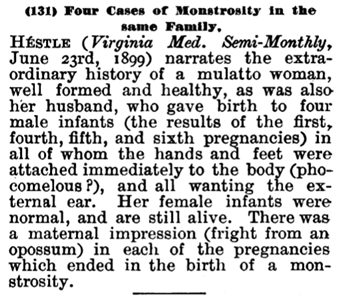
“An Epitome of Current Medical Literature: Pathology,” The British Medical Journal 2, no. 2015 (1899): 25–28. http://www.jstor.org/stable/20261541.